Field note
ch5
Advanced SQL
Outline:
- Accessing SQL From a Programming Language
- Functions and Procedures
- Triggers
- Recursive Queries
- Advanced Aggregation Features
Accessing SQL From a Programming Language
通常有两种方式来通过编程语言访问数据库:
- API(Application Programming Interface, 应用程序接口) — 通过函数调用来访问数据库
- Embedded SQL — 在编程语言中嵌入SQL语句
- The SQL statements are translated at compile time into finction calls
- At runtime, these function calls connect to the database using an API that provides dynamic SQL facilities
- 在编译的时候,这些 SQL 语句会被预编译,然后在运行时,这些预编译的 SQL 语句会被转换成函数调用,然后通过 API 来连接数据库
!!! Note “JDBC and ODBC”
- API for a program to interact with a database server
- ODBC(Open Database Connectivity) works with C, C++, C#
- JDBC(Java Database Connectivity) works with Java
- Embedded SQL in C
- SQLJ - embedded SQL in Java
- JPA(Java Persistence API) - Java ORM(Object-Relational Mapping) API
JDBC
JDBC supports a variety of features for qureying and updating data, and for retrieving query results.
JDBC also supports metadata retrieval, which allows a program to determine the structure of a database and the types of data stored in it.
Model for communication with the database:
- Open a connection
- Create a “statement” object
- Execute queries using the Statement object to send qureies and fetch results
- Exception mechanism to handle errors
public static void JDBCexample(String dbid, String userid, String passwd)
{
     try {
        Connection conn = DriverManager.getConnection(
            "jdbc:oracle:thin:@db.yale.edu:2000:univdb", userid, passwd);
        Statement stmt = conn.createStatement();
            … Do Actual Work ….
        stmt.close();
        conn.close();
     }
     catch (SQLException sqle) {
        System.out.println("SQLException : " + sqle);
     }
}
!!! Info “Try - catch 语句”
我们把可能会出现异常的代码放在 try 代码块中,如果出现异常了,就会跳到 catch 代码块中,然后执行 catch 代码块中的代码来处理异常。Update to database:
try{
    stmt.executeUpdate("INSERT INTO Students VALUES (‘Joe’, 12345, ‘CS’)");
} catch(SQLExecution sqle){
    System.out.println("Could not insert tuple." + sqle);
}
Execute query and fetch and print results:
ResultSet rset = stmt.executeQuery(
    "SELECT dept_name, avg(salary)
    FROM instructor
    GROUP BY dept_name");
while(rset.next()){
    System.out.println(rset.getString("dept_name") + " " + rset.getFloat(2));
}
我们看到,JDBC 中一个不方便的点在于,如果我们想获得每一列的数据,我们需要使用 rset.getString(dept_name) 或者 rset.getFloat(2) 这样的方式来获取数据,但是万一我们不知道这个数据的类型的话,就不能这么用了。
所以我们可以用 metadata 来获取数据的类型:
ResultSetMetaData rsmd = rset.getMetaData();
for(int i = 1; i <= rsmd.getColumnCount(); i++){
    System.out.println(rsmd.getColumnName(i));
    System.out.println(rsmd.getColumnTypeName(i));
}
这段程序可以输出每一列的名字和类型。
Prepared Statements
我们可以用占位符来代替具体的值,然后在执行的时候再传入具体的值,可以视为将 SQL 语句模版化,还可以防止 SQL 注入攻击。
PreparedStatement pStmt = conn.prepareStatement(
    "insert into instructor values(?,?,?,?)");
pStmt.setString(1, "88877");
pStmt.setString(2, "Perry");
pStmt.setString(3, "Finance");
pStmt.setInt(4, 125000);
pStmt.executeUpdate();
pStmt.setString(1, "88878");
pStmt.executeUpdate();
!!! Warning “SQL 注入攻击”
从用户端接收数据时,一定要用 Prepared Statements。“永远相信你的用户非蠢即坏”。

假如我们的查询语句需要用户输入查询的名字,而我们的查询语句是这样的:

```sql
"select * from instructor where name = '" + name + "'"
```

如果用户输入了 ```X' or 'Y' = 'Y```,那么这个查询语句就会变成:

```sql
"select * from instructor where name = 'X' or 'Y' = 'Y'"
```

就永远为真,这样就会泄露所有的数据。
MetaData
- ResultSet metadata
ResultSetMetaData rsmd = rset.getMetaData();
for(int i = 1; i <= rsmd.getColumnCount(); i++){
    System.out.println(rsmd.getColumnName(i));
    System.out.println(rsmd.getColumnTypeName(i));
}- Database metadata
DatabaseMetaData dbmd = conn.getMetaData();
ResultSet rs = dbmd.getColumns(null, "univdb", "department", "%");
// Arguments to getColumns: Catalog, Schema-pattern, Table-pattern,
// and Column-Pattern
// Returns: One row for each column; row has a number of attributes
// such as COLUMN_NAME, TYPE_NAME
while( rs.next()) {
    System.out.println(rs.getString("COLUMN_NAME"),rs.getString("TYPE_NAME");
}
Transaction Control in JDBC
- Can turn off auto-commit mode
conn.setAutoCommit(false)
- Transactions must then be committed or rolled back explicitly
conn.commit()conn.rollback()
SQLJ
SQLJ: embedded SQL in Java
#sql iterator deptInfoIter ( String dept name, int avgSal);
deptInfoIter iter = null;
#sql iter = { select dept_name, avg(salary) as avgSal from instructor
        group by dept name };
while (iter.next()) {
    String deptName = iter.dept_name();
    int avgSal = iter.avgSal();
    System.out.println(deptName + " " + avgSal);
}
iter.close();
加上 #sql 这个标签,就可以直接在 Java 代码中写 SQL 语句了。
ODBC
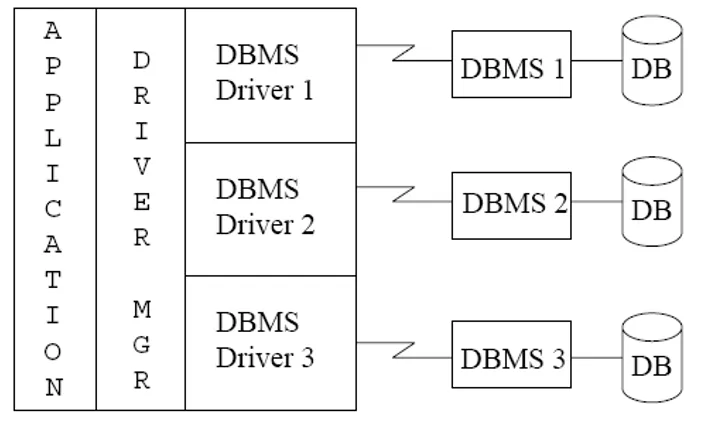
Each database system supporting ODBC provides a “driver” library that must be linked with the client program.
!!! Example
```C
int ODBCexample()
{
  RETCODE error;
  HENV    env;     /* environment */
  HDBC    conn;  /* database connection */
  SQLAllocEnv(&env);
  SQLAllocConnect(env, &conn);
  SQLConnect(conn, "db.yale.edu", SQL_NTS, "avi", SQL_NTS, "avipasswd", SQL_NTS);
  { …. Do actual work … }

  SQLDisconnect(conn);
  SQLFreeConnect(conn);
  SQLFreeEnv(env);
}
```

由于 C 没有 class, 所以所有的功能都是通过函数来实现的。
同一个数据库可能服务于多个对象,使用不同的编程语言,如字符串的结束标志也可能不同,所以需要用 SQL_NTS 来表示字符串的结束。
- Program sends SQL commands to database by using SQLExecDirect
- Result tuples are fetched using SQLFetch()
- SQLBindCol() binds C language variables to attributes of the query result
- When a tuple is fetched, its attribute values are automatically stored in corresponding C variables
- Arguments to SQLBindCol()
- ODBC stmt variable, attribute positionin query result
- The type conversion from SQL to C
- The address of the variable
- For variable-length types like character arrays,
- The maximum length of the variable
- Location to store actual length when a tuple is fetched
- Note: A negative value returned for the length field indicates null value
!!! Example
Main body of program

```C
char deptname[80];
float salary;
int lenOut1, lenOut2;
HSTMT stmt;
char * sqlquery = "select dept_name, sum (salary)
                              from instructor
                              group by dept_name";
SQLAllocStmt(conn, &stmt);
error = SQLExecDirect(stmt, sqlquery, SQL_NTS);
if (error == SQL SUCCESS) {
    SQLBindCol(stmt, 1, SQL_C_CHARx, deptname , 80, &lenOut1);
    SQLBindCol(stmt, 2, SQL_C_FLOAT, &salary, 0 , &lenOut2);
    while (SQLFetch(stmt) == SQL_SUCCESS) {
        printf (" %s %g\n", deptname, salary);
    }
}
SQLFreeStmt(stmt, SQL_DROP);
```
ODBC Prepared Statements
- Prepared Statement
- SQL statement Prepared: compiled at the database
- Can have placeholders: E.g.
insert into account values(?, ?, ?) - Repeatedly executed with actual values for the placeholders
- To prepare a statement
SQLPrepare()
- To bind parameters
SQLBindParameter(stmt, <parameter#>), ... type information and value omitted for simplicity...);
- To execute the statement
retcode = SQLExecute(stmt);
More ODBC Features
- Metadata features
- finding all the relations in the database
- finding the names and types of columns of a query result or a relation in the database
- By default, each SQL statement is treated as a separate transaction that is committed automatically
- Can turn off automatic commit on a connection
SQLSetConnectOption(conn, SQL_AUTOCOMMIT, 0);
- Transactions must then be committed or rolled back explicitly
SQLTransact(conn, SQL COMMIT);SQLTransact(conn, SQL ROLLBACK);
- Can turn off automatic commit on a connection
Embedded SQL
A language to which SQL queries are embedded is referred to as a host language, and the SQL structures permitted in the host language comprise embedded SQL.
如果把 SQL 嵌入到 Java 中,那么 Java 就是 host language.
EXEC SQLstatements is used in the host language to identify embedded SQL requests to the preprocessor.(in java, it is#sql)
Issues with Embedded SQL:
- Mark the start point and end point of Embedded SQL.
EXEC SQL <statement>
- Communication between database and programming language.
- SQLCA, SQLDA
- Address the mismatching issue between SQL and host lanugage.
- Handle result (set) with cursor
- Mapping of basic data types: SQL: date -> C: char(12)
!!! Example
```C
main( )
{
    EXEC SQL INCLUDE SQLCA; //声明段开始
    EXEC SQL BEGIN DECLARE SECTION;
    char account_no [11];    //host variables(宿主变量)声明
    char branch_name [16];
    int  balance;
    EXEC SQL END DECLARE SECTION;//声明段结束
    EXEC SQL CONNECT  TO  bank_db  USER Adam Using Eve;
    scanf (“%s  %s  %d”, account_no, branch_name, balance);
    EXEC SQL insert into account
        values (:account_no, :branch_name, :balance);
    If (SQLCA.sqlcode ! = 0) printf ( “Error!\n”);
   else printf (“Success!\n”);
}
```

注意:C语言与 SQL 语言有不匹配的地方,比如 C 语言中没有 date 类型,所以我们需要把 date 类型转换成 char 类型。
Procedural Constructs in SQL
- SQL provides a module language
- Permits definition of procedures in SQL, with
if-then-elsestatements,forandwhileloops, etc.
- Permits definition of procedures in SQL, with
- Stored Procedures
- Can store procedures in the database
- then execute them using the call statement
- permit external applications to operate on the database without knowing about internal details
SQL Functions
Define a function that, given the name of a department, returns the count of the number of instructors in that department.
    create function dept_count (dept_name varchar(20))
    returns integer
    begin
        declare d_count integer;
        select count (* ) into d_count
        from instructor
        where instructor.dept_name = dept_name
        return d_count;
    end
然后调用这个函数:
Find the department name and budget of all departments with more that 12 instructors.
select dept_namem budget
from department
where dept_count(dept_name) > 12;
函数还能返回一个 table:
Return all accounts owned by a given customer
    create function instructors_of (dept_name char(20) )
        returns table (ID varchar(5),
        			    name varchar(20),
                        dept_name varchar(20),
        			    salary numeric(8,2))
    return table
    	(select ID, name, dept_name, salary
    	from instructor
    	where instructor.dept_name = instructors_of.dept_name)
Usage:
select * from instructors_of('CS');SQL Procedures
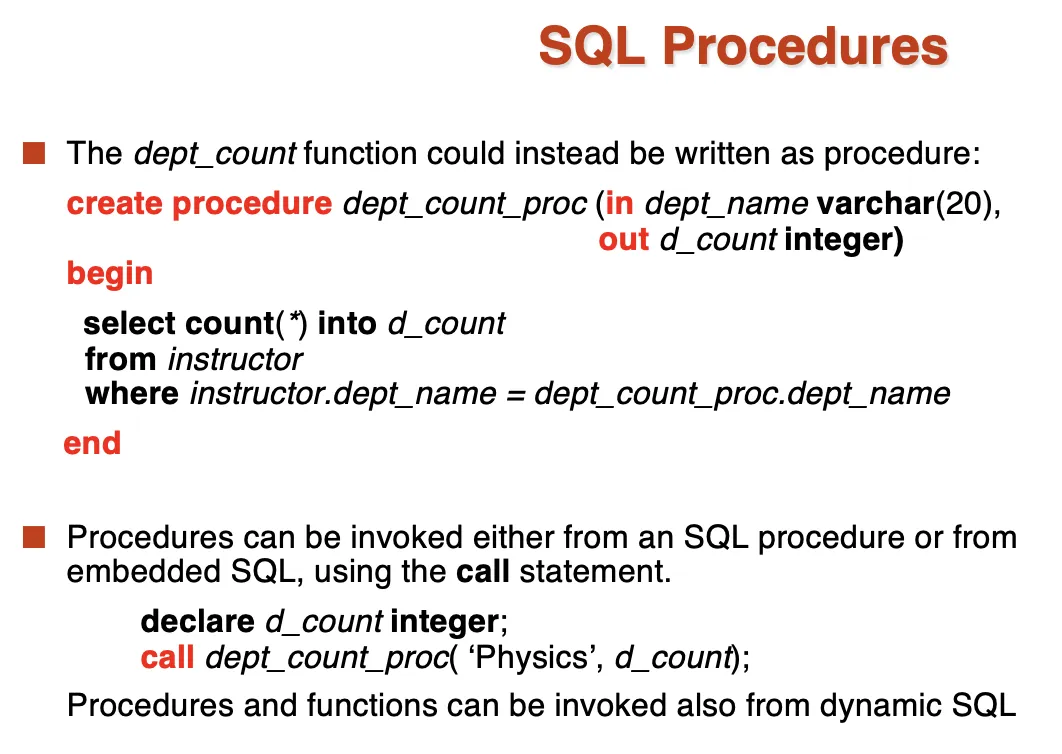
可以添加输入in 和输出out 参数。
Procedural Constraints
- Compound statement: begin … end,
- May contain multiple SQL statements between begin and end
- Local variables can be declared within a compound statement
- while and repeat statements:
declare n integer default 0;
while n < 10 do
    set n = n + 1
end while

repeat
    set n = n  – 1
    until n = 0
end repeat- for loop:
- Permits iteration over all results of a query
declare n integer default 0;
for r as
    select budget from department
    where dept_name = 'CS'
do
    set n = n - r.budget
end for- if-then-else statement:
if boolean expression
    then statement or compound statement
elseif boolean expression
    then statement or compound statement
else statement or compound statement
end if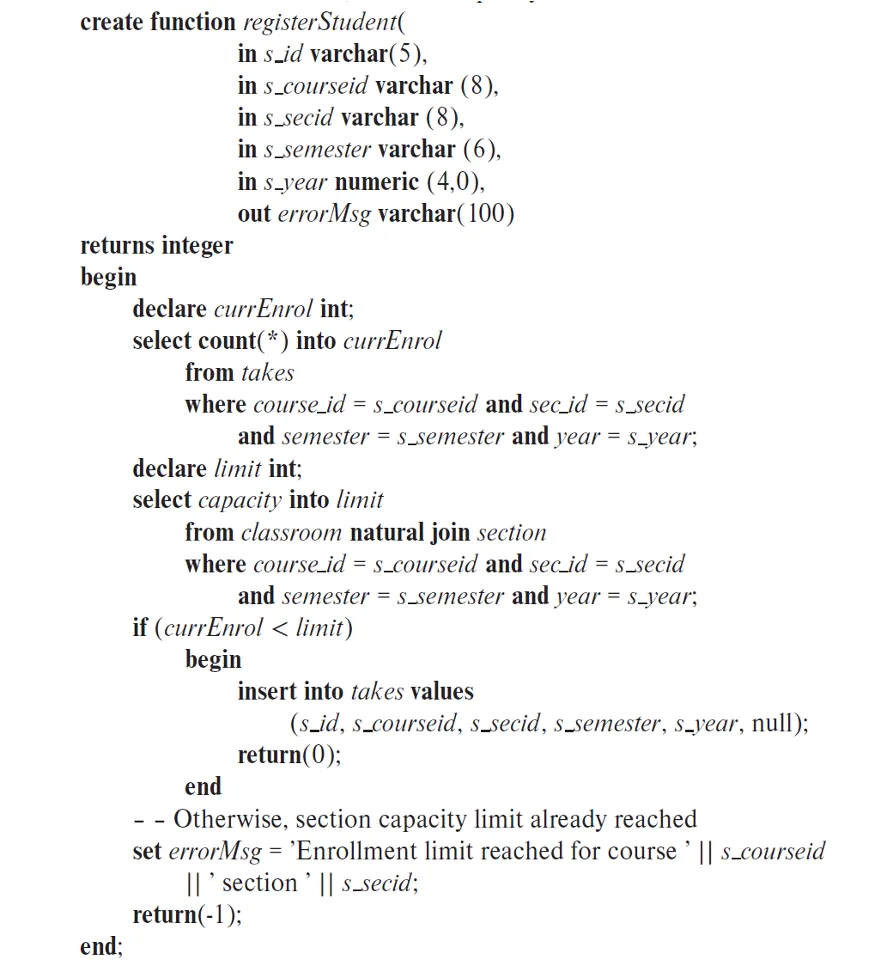
External Language Functions/Procedures
可以使用外部的由其他语言编写的函数和过程。
create procedure dept_count_proc(in dept_name varchar(20),
                                out count integer)

language C
external name '/usr/avi/bin/dept_count_proc'

create function dept_count(dept_name varchar(20))
returns integer
language C
external name '/usr/avi/bin/dept_count'
但是这样会出现一个问题,如果外部的程序是病毒,那么就会对数据库造成很大的危害。
所以一般在 sandbox 或容器中运行这些程序。
Triggers
- A trigger is a statement that is executed automatically by the system as a side effect of a modification to the database.
- Trigger - ECA rule
- E: Event(insert, delete, update)
- C: Condition
- A: Action
- To design a trigger mechanism, we must:
- Specify the conditions under which the trigger is to be executed.
- Specify the actions to be taken when the trigger executes.
!!! Example
```sql
create trigger account_trigger after update of account on balance
referencing new row as nrow
referencing old row as orow
for each row
when nrow.balance - orow.balance > =200000 or
     orow.balance  -nrow.balance >=50000
begin
    insert into account_log values (nrow.account-number, nrow.balance-orow.balance , current_time())
end
```
!!! Example “time_slot_id”
```sql
create trigger timeslot_check1 after insert on section referencing new row as nrow
for each row
when (nrow.time_slot_id not in (
        select time_slot_id
        from time_slot)) /* time_slot_id not present in time_slot */
begin
    rollback
end;

create trigger timeslot_check2 after delete on timeslot
referencing old row as orow
for each row
when (orow.time_slot_id not in (
        select time_slot_id
        from time_slot) /* last tuple for time slot id deleted from time slot */
    and orow.time_slot_id in (
        select time_slot_id
        from section)) /* and time_slot_id still referenced from section*/
begin
    rollback
end;
```

虽然 ```time_slot_id``` 不是 ```primary key```, 我们仍然可以设计一个触发器来保证 ```time_slot_id``` 的引用完整性。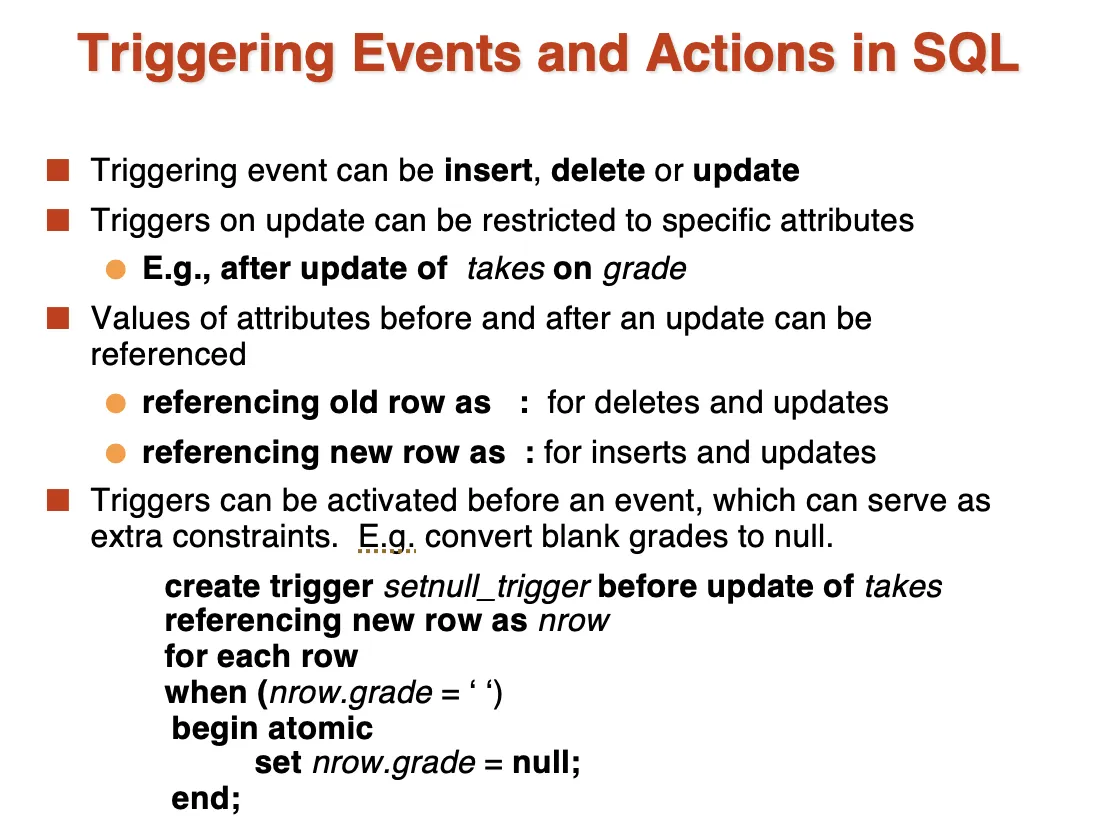
Statement Level Triggers
除了 for each row 之外,还有 for each statement.
前者是对每一行进行操作,后者是对每一条语句进行操作。
Instead of executing a separate action for each affected row, a single action can be executed for all rows affected by a transaction.
- Use
for each statementinstead offor each row - Use
referencing old tableorreferencing new tableto refer to temporary tables (called transition tables) containing the affected rows. - Can be more effective when dealing with SQL statements that update a large number of rows.
!!! Example
```sql
create trigger grade_trigger after update of takes on grade referencing new table as new_table
for each statement
when exists(select avg(grade)
            from new_table
            group by course_id, sec_id, semester, year
            having avg(grade)< 60 )
begin
    rollback
end
```